Idea LLM Travel
AI & LLM Applications in Travel
Artificial Intelligence (AI) is the simulation of human intelligence in machines programmed to think, learn, and make decisions. It includes subfields like:
- Machine learning
- Natural language processing
- Computer vision
- Robotics
AI enables systems to perform tasks such as understanding language, recognizing patterns, and making recommendations based on data.
Large Language Models (LLMs) are AI systems trained on vast text corpora to understand and generate human-like language. Examples include:
- GPT
- Claude
- LLaMA
LLMs can be used for:
- Chatbots
- Document summarization
- Content generation
- Agentic reasoning when integrated with tools, APIs, or workflows
Enhancing Travel Algorithms with AI/LLM
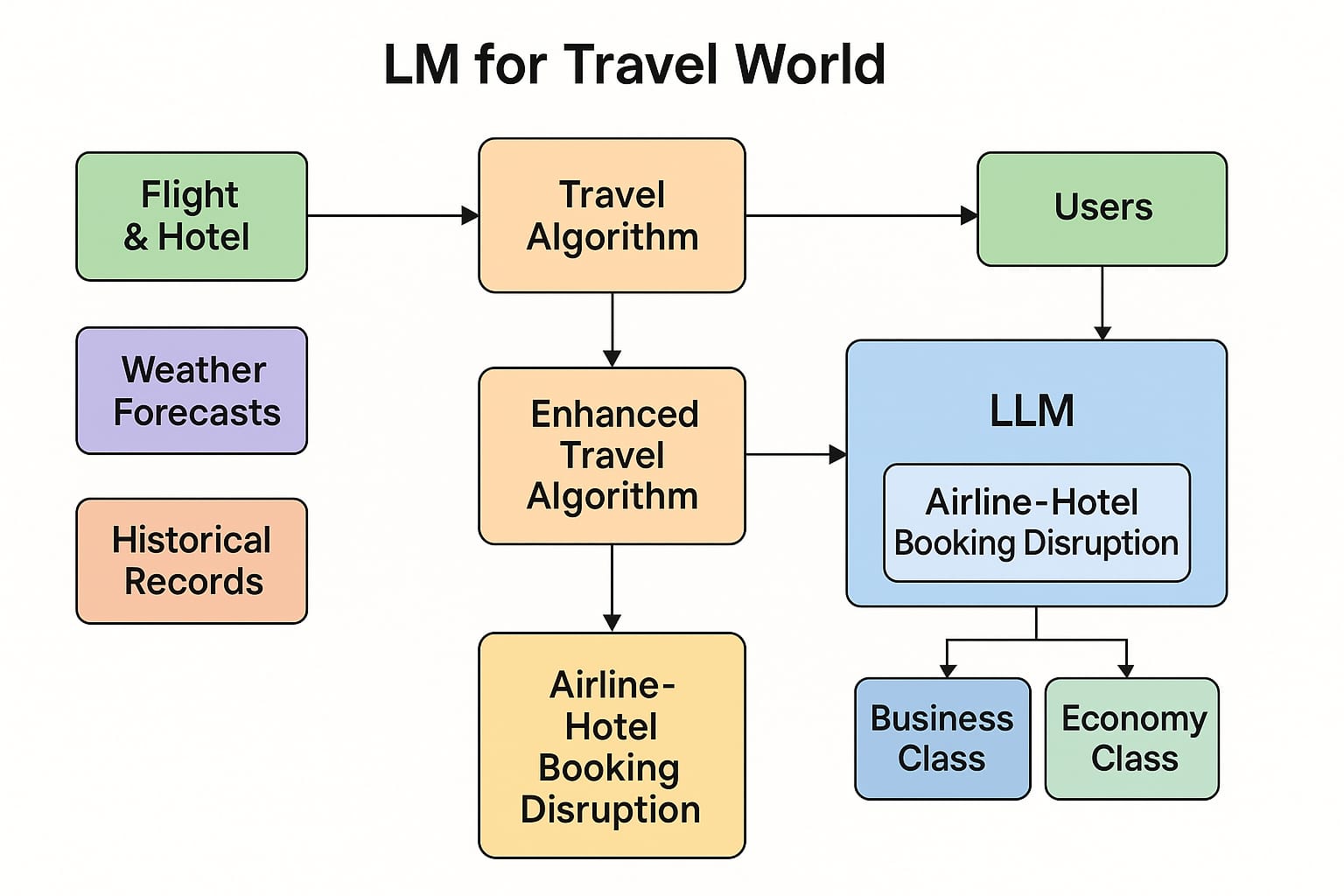
The airline-hotel disruption algorithm leverages multiple booking and cancellation scenarios due to weather, delays, or overbookings. To enhance it with AI/LLM:
- Use LLMs to interpret unstructured data from customer complaints, airline notifications, and real-time travel feeds.
- Incorporate NLP-based models to dynamically match hotel availability with affected passengers' needs.
- Add predictive analytics to forecast delays or cancellations based on historical and weather data.
- Implement reinforcement learning to optimize rebooking routes and costs based on traveler priority, class, or loyalty.
- Integrate real-time APIs for flight/hotel updates to ensure continuous decision-making.
- Use LLMs as agents to negotiate cancellations/refunds/rescheduling via APIs autonomously.
- Automate communications through multi-lingual chatbots to assist disrupted passengers 24/7.
- Include sentiment analysis to prioritize passengers with negative experiences.
- Add adaptive pricing models using ML to find nearby accommodations during peak disruptions.
- Personalize recommendations using traveler history, trip intent (business/leisure), and urgency.
Current Processes and Data Availability
Currently, data available includes:
- Flight and hotel APIs (e.g., Skyscanner, Amadeus, Sabre)
- Weather forecast APIs for route planning
- Historical disruption/cancellation records
- Booking metadata (PNR, class, loyalty status, etc.)
- Customer support logs and complaint tickets
- Real-time availability from OTA platforms (Expedia, Booking.com)
- Regulatory rules from aviation bodies (e.g., EC261 in Europe)
Processes involve:
- Rule-based itinerary planning
- Manual or semi-automated rescheduling
- Batch processing for mass disruptions
- Use of business logic over AI in most legacy systems
Parameters and AI Data Enrichment
Typical parameters include:
Flight/hotel ID, class, price, occupancy, weather delay codes, passenger status, location proximity, refundability, loyalty tier, event-based peak data.
Using AI:
- Cluster passengers by urgency, purpose of travel, or mobility needs
- Use image recognition (e.g., boarding passes, IDs) for instant validation
- Apply NLP on customer feedback to classify sentiment and urgency
- Use reinforcement learning to fine-tune disruption handling over time
- Predict alternate routing using geospatial + event correlation
- Enrich profiles using open travel datasets (e.g., IATA, GTFS)
- Extract structured data from unstructured logs and emails (via LLM)
- Derive real-time confidence scores for each rebooking offer
- Optimize cost vs. satisfaction via multi-agent simulation
- Segment accommodations by amenities, reviews, and walkability using LLMs
LLM Implementation Strategy
To generate or fine-tune an LLM for this use case:
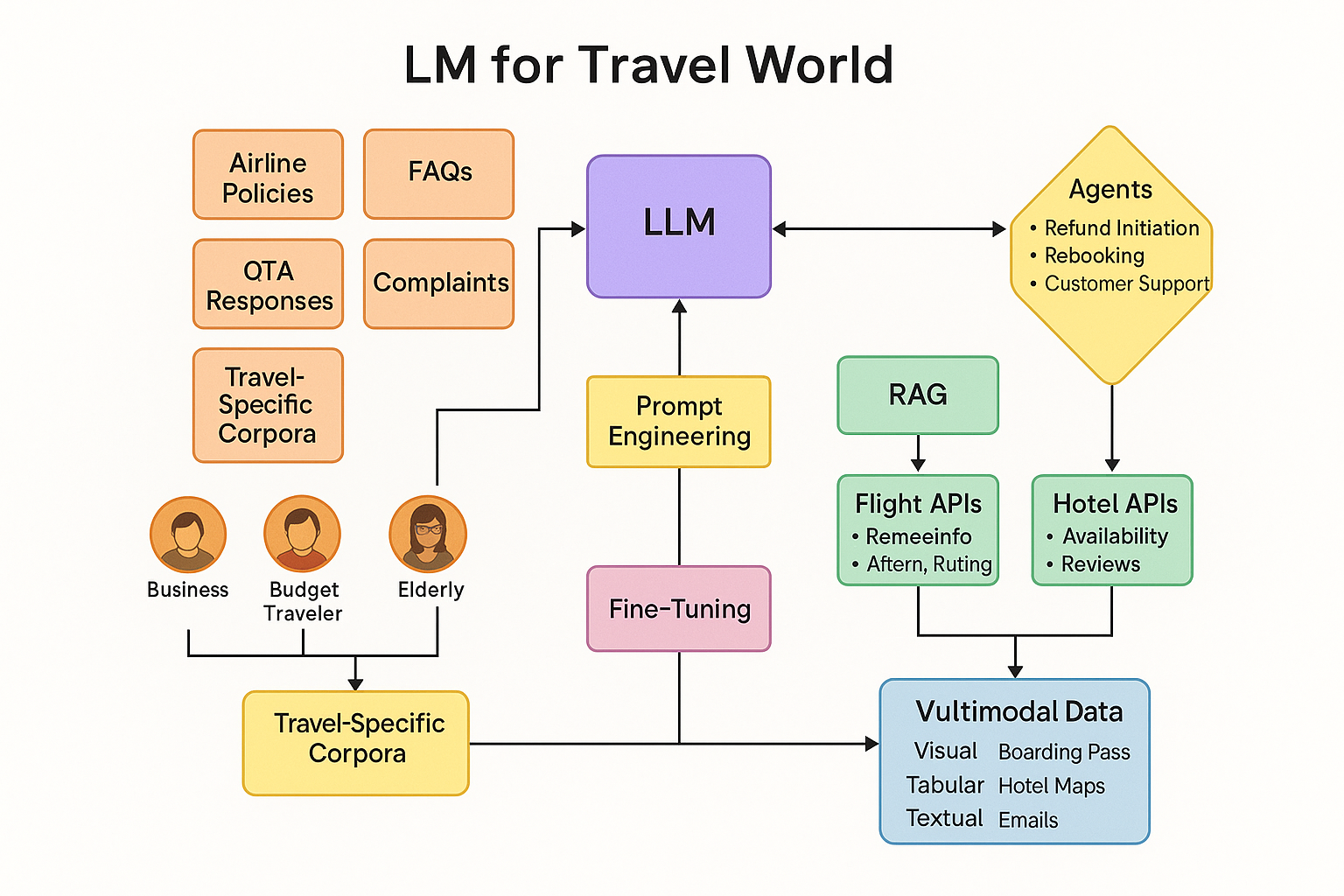
- Collect travel-specific corpora: airline policies, FAQs, OTA responses, complaints
- Fine-tune open-source LLMs (e.g., LLaMA, Mistral, Mixtral) using tools like Hugging Face with domain-specific prompts
- Use RAG (Retrieval-Augmented Generation) to inject real-time hotel/flight info during inference
- Implement prompt engineering for various personas (business, budget traveler, elderly)
- Integrate multimodal data handling for visual (boarding pass, hotel map), tabular (flight logs), and textual (emails)
- Use agents (LangGraph, AutoGen, CrewAI) to represent steps like refund initiation, rebooking, and customer support independently but cooperatively